

Index
- Current Context
- How Does Germany Vote?
- What Is the Economic Situation?
- What Kind of Party Is This?
- The Alternative for Germany (AfD)
- What Are the Party’s Goals?
- Is the Party Democratic?
- Who Really Benefits from the Party?
- Who Are the Voters?
- Why Eastern Germany?
- Why Is the Male Worker the Focus?
- Socioeconomic Factors of the Average Voter
- Why the AfD Appeals in This Milieu
- Can Voters Be Brought Back into the Democratic Spectrum?
- Conclusion for Political Practice
International politics
Rightward Shift Driven by Fear of Decline: When Inequality Radicalizes Politics
Fear of downward mobility votes right. How wealth inequality and economic frustration shape current polling trends.
https://conciencia-democratica.org/articulos/rechtsruck-durch-abstiegsangst?lang=enBy Lukas EffingerJune 16, 20266 min read
Current Context
How Does Germany Vote?
Below is the 2026 federal election result (left bars) alongside current polling trends. The current government, led by Chancellor Friedrich Merz, is formed by the CDU/CSU and the SPD.

Comparison of the 2026 election result with current polling trends for parties represented in the Bundestag (CDU/CSU, SPD, Greens, FDP, Left Party, AfD). The AfD is the only party recording significant gains in the polls, despite the firewall maintained by established parties and the government’s Merz-led efforts to stabilize the economy. Source: dawum.de (accessed: 10 June 2026), licensed under Creative Commons CC BY-NC-SA 4.0.
What Is the Economic Situation?
The latest DIW Wochenbericht (Weekly Report) 24/2026 paints a picture of sluggish economic activity: weak growth, persistent inflation slightly above the ECB’s target, high energy costs as a lingering effect of geopolitical shocks (Ukraine, Middle East), and an industrial sector still in transition. The full forecast with graphics also includes sectoral comparisons and employment projections.
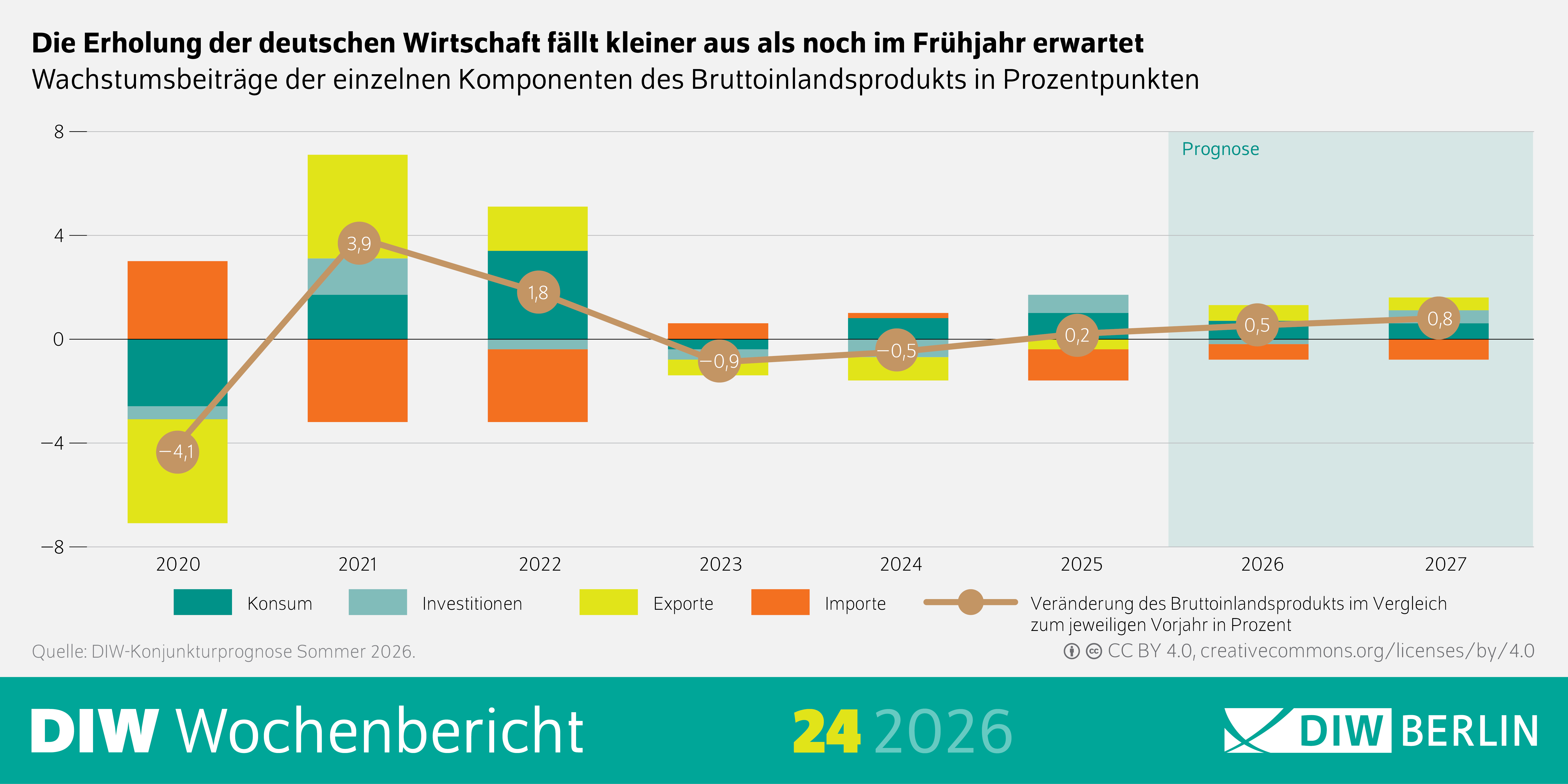
The difficult economic conditions—triggered by geopolitical conflicts such as the wars in Ukraine and the Middle East, the resulting price shocks, and the challenges of economic transformation—have fueled deep societal dissatisfaction with governing politicians. But why is it the AfD that is successfully mobilizing the votes of those disappointed by current politics, the previous government, or the system itself?
What Kind of Party Is This?
The Alternative for Germany (AfD)
Founded in 2013 and initially described as a liberal-conservative party, the AfD rapidly evolved into a right-wing populist—and in parts right-wing extremist—force.
What Are the Party’s Goals?
The AfD calls for a fundamental shift in migration policy, emphasizing restrictive border controls, mass deportations ("remigration"), and the abolition of the right to asylum. In economic and energy policy, it advocates tax cuts, the removal of climate protection regulations, and a return to fossil and nuclear energy sources. It also seeks to weaken the powers of the European Union in favor of national sovereignty, the abolition of the euro, and a traditional model of family and society.
Is the Party Democratic?
The party and its state associations are classified by Germany’s Federal Office for the Protection of the Constitution (Bundesamt für Verfassungsschutz) as either a suspected case of right-wing extremism or, in some cases, as definitively right-wing extremist. Many party members maintain ties to various ultra-right or right-wing extremist groups.
There are numerous civil society initiatives pushing for the Federal Constitutional Court to review the party’s constitutionality (see, for example, afd-verbot.de/beweise or pruef-demos.de). Given the available evidence, the party’s hostility to democracy is widely discussed in public discourse.
Who Really Benefits from the Party?
The AfD’s tax-cutting plans would primarily benefit high earners and the wealthy, as it proposes abolishing progressive taxation, eliminating the solidarity surcharge, and drastically reducing or abolishing wealth-related taxes such as inheritance and property taxes. Its rollback of climate protection measures and return to fossil fuels would benefit the fossil fuel industry—and, given the central role of pipeline gas, especially Russia.
Who Are the Voters?
Statistically, the typical AfD voter is between 25 and 44 years old, lives in rural areas (particularly in eastern Germany), has a low to medium level of formal education, and earns a low to medium income as a worker or is unemployed.
Why Eastern Germany?
More than 35 years after the fall of the Berlin Wall and reunification, incomes and wealth in eastern Germany still lag significantly behind those in the west. Overlaying maps of election results with income distribution reveals clear correlations.


Two comparative maps of Germany: on the left, the regional distribution of AfD votes; on the right, household disposable income. Darker shades indicate higher values. The overlay shows a clear correlation—the AfD performs particularly strongly in rural regions of eastern Germany that have lagged economically since reunification. Sources: bpb.de — AfD election results and voters and Deutschlandatlas — Household disposable income (accessed: 10 June 2026).
Why Is the Male Worker the Focus?
The modern labor market increasingly demands higher educational qualifications. Women and children from academic households benefit disproportionately from this trend. At the same time, societal change has seen more women enter the workforce, directly competing with men.
In much of eastern Germany, the situation is exacerbated: companies are heavily concentrated in western Germany or the region’s metropolitan areas, leaving rural areas with high unemployment. Compounding the issue, the parental and grandparental generations were largely unable to accumulate or pass on wealth after reunification, as wages never reached western levels and no wealth was inherited from the former GDR. Young, well-educated women are particularly likely to migrate from rural eastern Germany to major cities, leaving behind a significant surplus of men. Among the remaining men, there is a growing longing for a conservative family model (kitchen, church, children).
Socioeconomic Factors of the Average Voter
The prototypical voter in this region, with low income and little prospect of a meaningful inheritance, has no realistic chance of homeownership or retirement security free from existential anxiety. The acute surplus of women also increases the risk of remaining involuntarily single.
Compounding these challenges is job precarity: in economically weak regions, employment is already unstable and now faces additional threats from automation, industrial robots, and artificial intelligence (AI). Formal educational deficits often prevent access to retraining programs that could offer an escape from this deadlock.
Why the AfD Appeals in This Milieu
In this fertile ground of inequality in education, income, wealth, and future prospects, the AfD exploits the simplistic answers of right-wing populism:
- Scapegoating rhetoric over job loss: The fear of unemployment and downward mobility is deliberately projected onto immigrants and climate protection (demands for immigration bans and "remigration").
- Redistributive grievances over income: Low personal income is linked to social benefits for refugees and recipients of citizen’s income to stoke resentment.
- Compensation for social isolation: The lack of prospects for partnership and a future is blamed on the "woke," progressive, and academic urban lifestyle. The party caters to the desire for a re-patriarchalization that revives traditional male dominance and reduces women to a domestic, mother-centered role.
Can Voters Be Brought Back into the Democratic Spectrum?
An analysis by Tagesschau of the 2025 federal election reveals that the main motives of AfD voters fall into two clearly distinct blocs—protest against established politics (about half of the votes) and ideological alignment with the party’s platform (the other half). The full analysis with all motive graphics is available on Tagesschau.
The data show that the AfD’s electorate is not a homogeneous mass. Two main groups can be distinguished:
- The ideological core: A segment of the electorate is firmly bound to the party by a coherent right-wing extremist, racist, and anti-state worldview. This group is effectively unreachable for democratic discourse and rational argument ("democratically lost").
- Protest voters / the disillusioned: The remainder vote primarily out of disappointment, fear for the future, and protest against established politics. They respond to real existing inequalities and the lack of prospects in rural areas.
Conclusion for Political Practice
Right-wing populism thrives where people feel structurally left behind. Targeted structural and economic policies that reduce inequalities between urban and rural areas, east and west, rich and poor, and highly educated and less educated would undermine the foundations of populist narratives. While the ideological core must remain isolated, protest voters can be won back for democracy through policies that provide material and social security as well as genuine future prospects.
Share
For Instagram: copy the link and paste it in your story or DM.
Continue with

International politics
We Have Been Warned
Global war is closer than we think.
Bernardo Gortaire Morejón

International politics
A SOCIETY TURNED OFF BY THE LIGHT
When the night disappears under the artificial glow, we don't just lose the stars: we lose sleep, biodiversity, and the ability to contemplate. An analysis of the invisible costs of light pollution.
Pedro Joaquin Villagra Delgado

International politics
«The Last Bullet for Democracy»: The Merz Government Faces State Elections
The CDU/CSU-SPD coalition under Chancellor Friedrich Merz, the most unpopular in recent history, confronts three decisive state elections in September 2026.
Lukas Effinger
Comments
No comments yet. Open the conversation.
Sign in to comment. Sign in